
Features
Part of 7 notes on professional lookalikes worth reading
Professional lookalike history: substitutes, stage acts and film doubles
A history of lookalike and impersonation work from medieval office substitutes to stage acts to film doubles, and why resemblance was never just about the face.
The trade of looking like somebody else is older than photography and older than celebrity. It has been reorganized several times, and each reorganization changed what the job actually consists of. Following that sequence is more useful than any roster of practitioners, because the structure explains why the work is what it is now.
What to take away
- The earliest versions of the trade were about rank and office rather than about fame, and the resemblance was to a role.
- Stage impersonation made the work about performancevoice, gait and timing.
- Film created the technical double, a job defined by matching a silhouette in a shot rather than a person in a room.
- The current market rewards a designed likeness, assembled by hair, wardrobe and rehearsal.
Standing in for an office
Long before anyone was famous for being photographed, powerful people used substitutes. The purpose was practical: someone had to occupy a position, appear in a procession, or take a risk.
The substitute was matched on the things visible at a distance, meaning height, build, dress and bearing, because that is all an audience of any size could see.
Documented cases in England run from the 14th century. At the funeral of Edward II in 1327, a dressed wooden effigy of the king was carried in the procession, and the visible match was robe, posture and height. Later monarchs and their consorts were represented in the same way: the funeral effigies carried for them, many of them wax figures, survive in the collection at Westminster Abbey.
That sets the pattern for everything after. The resemblance being purchased was to a role, not to a face, and the role came with a costume that carried most of the recognition.
The stage impersonator
Variety and music hall turned imitation into a performance discipline. The form ran in Britain and North America from roughly the 1850s to the 1930s. Before that, Charles Mathews filled solo shows in the 1810s and 1820s with imitations of people he had met.
The materials were voice, phrasing, walk, catchphrase and posture, and the make-up was broad because the room was large.
Audiences accepted a likeness that would not survive a photograph, because they were not being asked to compare a photograph. They were being asked to recognize a person from a performance.
This is where the trade's real craft knowledge was built, and it has not been superseded. A performer who has the movement will be read as the person; a performer who has only the face will not. The stack of styling and manner that sits over a face is the same stack a stage impersonator works with.
The film double, and the arrival of the shot
Film introduced a different job. A production needs somebody to be in a frame doing something the lead cannot or should not do, and what matters is that the shot cuts together.
Studio doubling settled in during the 1910s. The work of standing in for a performer in specific shots is matched on outline, build, hair and continuity of costume, and the camera is placed to help.
Casting works by type, not by face. Type-casting is a formal trade with its own conventions, and doubles are cast inside it. A production hires by build, hair and matching wardrobe, then places the camera to cover the difference.
Betty Danko doubled Margaret Hamilton for the fiery exit in The Wizard of Oz (1939), a shot matched on costume, height and silhouette.
What changed in the modern market
What was being matched
- Office and procession, antiquity to the 1600s
- Rank, height, bearing, dress
- Stage impersonation, 1850s to 1930s
- Voice, walk, timing, catchphrase
- Film doubling, 1910s onward
- Silhouette, build, hair, continuity
- Event and corporate work, 1970s onward
- A recognizable public image
Where the resemblance was made
- Office and procession, antiquity to the 1600s
- The costume and the distance
- Stage impersonation, 1850s to 1930s
- The performance
- Film doubling, 1910s onward
- The shot and the camera position
- Event and corporate work, 1970s onward
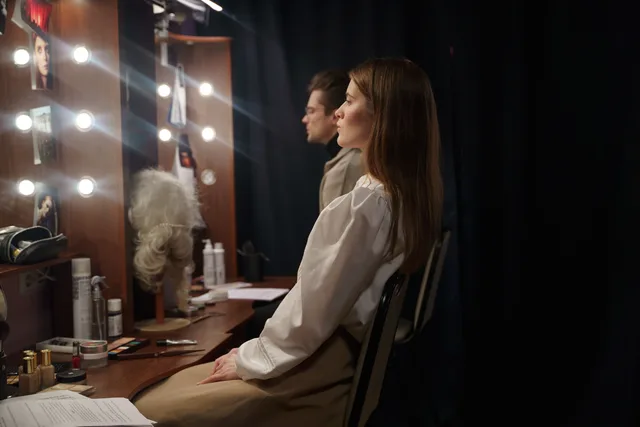
- Hair, wardrobe, rehearsal and context
The right-hand column is the interesting one. The same substitution runs through ordinary comparisons, where the camera does what the costume department used to.
Elvis Presley impersonation after his death in 1977 is the best documented part of the current market. Elvis Presley Enterprises, which runs Graceland in Memphis, licenses the official image and stages the Ultimate Elvis Tribute Artist Contest there. Shows such as Legends in Concert supply the stage version of the same trade, with a live band and a nightly act.
Where resemblance was made
Era
- Office and procession
- Rank, height, dress
- Stage impersonation
- Voice, walk, timing
- Film doubling
- Silhouette, build, hair
- Event and corporate
- Recognizable public image
Matched
- Office and procession
- Costume and distance
- Stage impersonation
- The performance
- Film doubling
- Shot and camera
- Event and corporate
- Hair, wardrobe, rehearsal
Made by
- Office and procession
- Stage impersonation
- Film doubling
- Event and corporate
Named practitioners and doubles
The work was usually uncredited, so the record is short. Vesta Tilley was a headline male impersonator in Britain by the 1890s. Chuck Roberson doubled John Wayne across Westerns from the early 1950s into the 1970s.
Yakima Canutt doubled John Wayne and staged the stunt sequences he appeared in. Vic Armstrong doubled Harrison Ford across the Indiana Jones films. In both cases the hire was a technical one, made by the production rather than by an audience.
For The Lord of the Rings (2001 to 2003), scale doubles and forced perspective let performers of different heights share a frame.
Why the history matters for the claim
The tradition can produce a convincing likeness by working on everything except bone structure. A casual claim that two people look alike is a claim about a much smaller thing than it sounds. It is also a claim being made without any of the tools the tradition uses to check its work.
The trade has one further lesson. Every performer in it consented and was paid, and controls the use of their own image. That is the reason no pairings appear here and why an unasked comparison behaves the way it does.
Common questions
Was the historical use of substitutes as common as stories suggest?
Stories about it are far more common than documented cases. The practice existed, and part of the record is physical: the royal funeral effigies survive at Westminster Abbey and can be examined today. Accounts that name no funeral, no archive and no source should be treated carefully.
Is impersonation the same trade as doubling?
No. One is a performance for an audience, the other is a technical match for a camera. They need different skills and are hired by different people.
Why do modern acts spend so much on hair and wardrobe?
Because that is where the recognition is produced, and it is the part that can be changed.