Features
Why Historical Lookalikes Rarely Hold Up
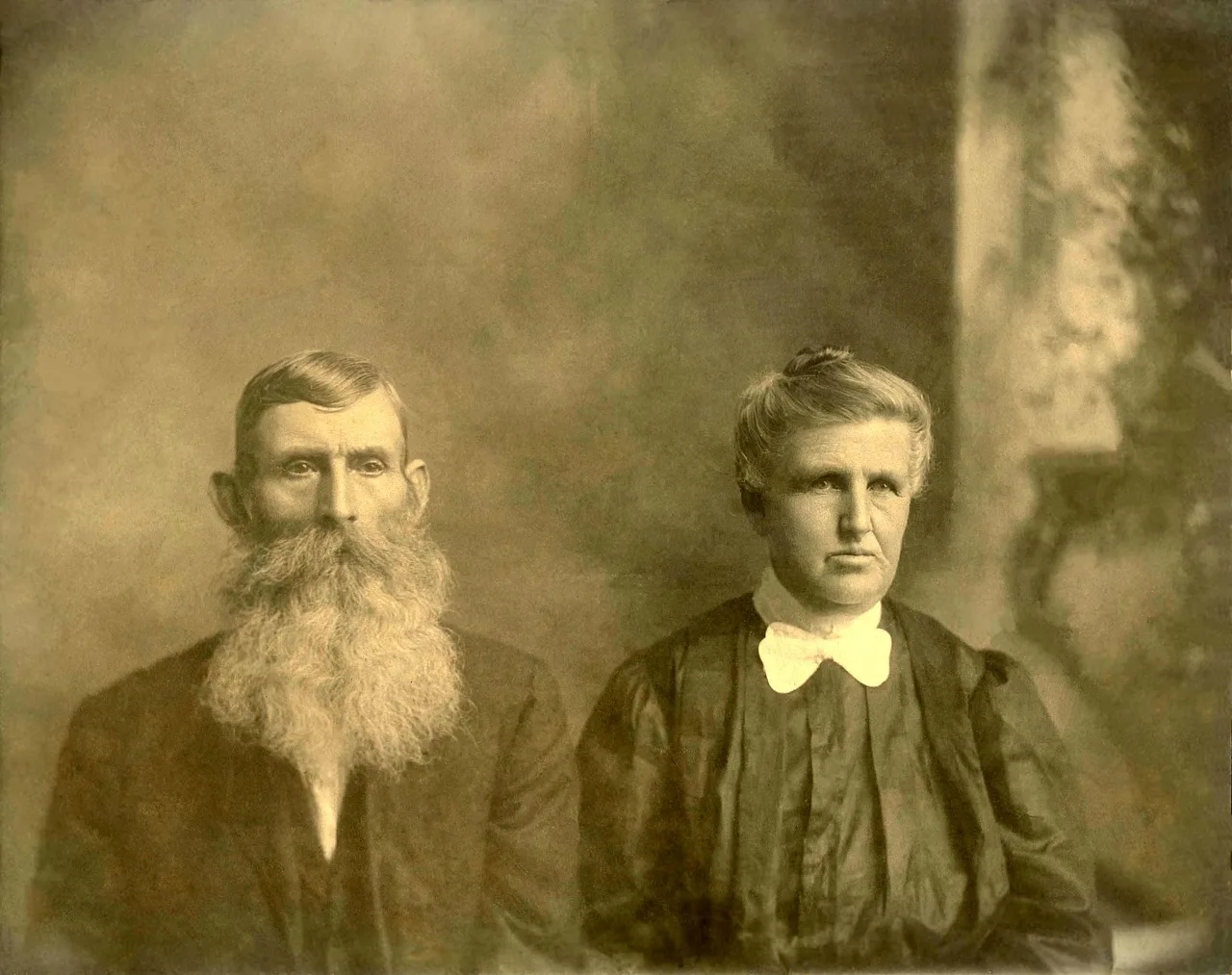
Historical lookalikes usually fall apart on inspection: standardized studio poses, period styling, degraded copies, and restorations that invent detail.
Every so often an old photograph goes round with a claim attached. The person in it is the double of someone alive now, or a face from a century ago belongs to somebody who should not have been there.
The claims are entertaining, and the thing about historical lookalikes is that they are almost always about the photograph, not the face. Old images were made under technical constraints and social conventions that pushed very different people toward looking alike.
Then the surviving copies were degraded, retouched, reprinted and rescanned on the way to your screen. By the time you see it, much of what you read as a face came from everything except the person.
What to take away
- Early portraits were made under constraints that standardized pose, expression and lighting across millions of sitters.
- Period styling does most of the work. An era can resemble itself far more than two people do.
- Restored, colorized and upscaled images contain detail that was generated rather than recovered.
The claims that keep coming back
The historical lookalike has a small canon, and it is almost entirely celebrity. A nineteenth-century carte de visite of a heavy-lidded young man with a strong jaw is passed around as proof that Nicolas Cage is a time traveler. A studio portrait of a bearded man in a stiff collar and dark coat is offered as an earlier portrait of Keanu Reeves.
Both are ordinary mid-nineteenth-century portraits, made in the same studios, to the same templates, under the same technical constraints as thousands of others. The claim attached to each rests on nothing except the resemblance itself. That is the pattern this page is about.
The old photograph is a manufactured object
The earliest photographic portraits were technically demanding, and the demands shaped the result.
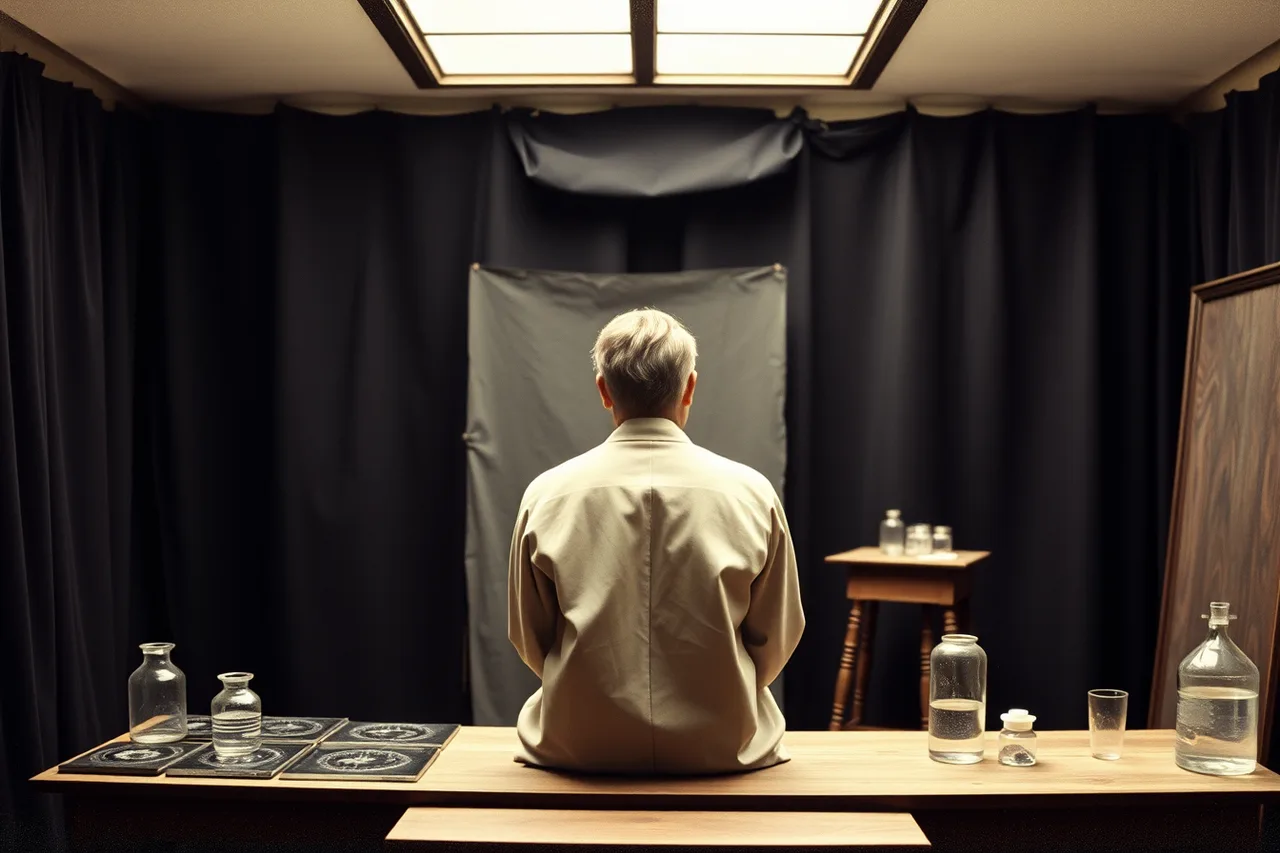
Exposures were long. Sitters had to hold still, which is why so many nineteenth century faces carry the same neutral, slightly strained expression: it is the only one a person can hold for the length of the exposure. Head rests and posing stands kept the subject steady.
The daguerreotype process that opened the era produced a single reflective plate. It was usually taken in a studio with a fixed lighting arrangement, at a fixed distance, with the sitter facing the camera in one of a few accepted positions.
The processes that followed one another through the century — the ambrotype on glass, the tintype on a thin iron plate, the paper calotype used in Britain — changed the chemistry and the look but not the setup. Fixed camera position, fixed light, a sitter instructed where to put the hands and where to look.
Then came the interventions. Negatives were retouched by hand to smooth skin and adjust features, because that was a service customers paid for. Prints were toned. A studio developed a house style and applied it to everyone who walked in.
Some studios turned that into a signature. Mathew Brady's rooms in New York and Washington and the Boston firm Southworth & Hawes are the well-known examples, but the point holds for every local operator with a backdrop and a set of poses. A customer was buying a picture in the studio's style, and that shared style is what later readers mistake for a shared face.
So the image you are comparing is not a record of a face in a room. It is the output of a process designed to produce a particular kind of picture from any face presented to it.
Standard formats produced standard pictures
The economics reinforced the technique. Once portraits became a mass product, they were made to a standard size, mounted on standard card, in standard poses, against a small set of studio backdrops. The carte de visite format was traded and collected in albums, which gave photographers a strong reason to keep every sitting to the same template.
Standard format vs modern snapshot
Standard studio portrait
- Framing
- fixed template
- Distance
- fixed
- Lighting
- studio arrangement
- Pose
- few accepted positions
- Expression
- held neutral
- Variation
- stripped out
Modern snapshot
- Framing
- varies freely
- Distance
- varies
- Lighting
- whatever is there
- Pose
- unposed
- Expression
- spontaneous
- Variation
- high
The result is a vast body of images in which framing, distance, lighting, pose and expression barely vary. Strip that much variation out of a set of photographs and the remaining differences between two strangers can look smaller than the differences between two modern snapshots of the same person.
Painted portraiture from earlier periods does the same thing more strongly. Pose, palette, dress and attributes followed convention, and the sitter's likeness was one input among several to a picture that also had to signal rank and piety and family. A shared convention is not a shared face.
The period is doing the resembling
Hair, facial hair, collars, hats and spectacles change with fashion, and they change together across a whole population.
A face framed by the same hairline, beard shape, and high collar as another face from the same decade reads as similar. The frame is what the visual system uses first.
That mechanism also produces confident modern pairings, detailed in celebrity lookalikes. The historical version is stronger because styling was more uniform than anything today.
Ask what the impression survives. Remove the period markers, and if there is nothing distinctive left, the resemblance belonged to the decade.
What survives the journey to your screen
Very few of these images reach you as the photographer made them.
- Copies of copies.A print was rephotographed, reproduced in a book as a halftone screen, scanned from that book, saved as a compressed file, reposted and recompressed.
- Contrast and damage.Fading, staining, scratching and heavy-handed adjustment all move edges and shadows, which is exactly where facial structure is read.
- Colorization.Color added later is invented. It is an interpretation of tone, sometimes carefully researched and always a guess about eyes, hair and skin. The tools doing it include MyHeritage's colorization feature and the open-source DeOldify.
- Upscaling and restoration.Modern tools that sharpen a blurred face, such as the Remini app, do not recover lost information, because the information is not there. They generate plausible detail consistent with the training data. The face becomes crisper and less true, and the invented parts are precisely the fine features people then compare.
An enhanced portrait is a new picture with an old picture inside it. Any resemblance found in the added detail is a resemblance to the tool.
Base rates and the images you never see
Two statistical problems sit under every historical match.
The surviving photographic record is a small, unrepresentative sample. It over-represents people who could afford a portrait, in places with studios, in the periods and communities where images were kept. A claim about how unlikely a resemblance is has no denominator, because nobody knows the size or shape of the pool.
You only ever see the hits. Enormous numbers of old faces are looked at and passed over.
The ones that circulate struck somebody as familiar. That guarantees every example you encounter was selected for the property being claimed. Selection like that will produce a steady supply of astonishing images from an archive containing nothing astonishing.
Identifying a person in an old photograph is real work
There is a serious version of this question, and it looks nothing like a side-by-side post.
Archives and family historians identify sitters through provenance: origin, who held it, back inscription, studio records. That work is done in institutions such as the Library of Congress, the National Archives, the Getty Research Institute and the Smithsonian's National Portrait Gallery, and in state archives and genealogical societies, where portrait collections are catalogued item by item.
Then what the mount and process date the image to, and what clothing and insignia narrow it to. Whether an independently documented portrait of the same person exists.
A caption is a claim by its writer, and one added generations later is a claim about a claim.
Good archives are careful about this in a way that is worth copying. They label items unidentified, attributed to, or possibly, and they keep the uncertainty attached to the record instead of quietly resolving it. That habit is the whole difference between a historical identification and a guess with a confident voice.
Why the time traveler genre never resolves
The recurring claim, that a face in an old crowd shot belongs to a modern person, cannot be settled, and its structure guarantees that.
Two images carry most of the traffic. One is a crowd photograph taken at the reopening of the South Fork Bridge in British Columbia in 1941, in which a young man in sunglasses and a patterned sweater is said to have come from a later decade. The other is a 1928 Hollywood premiere photograph in which a woman holds a small dark object to her ear and is said to be using a mobile phone.
Neither picture contains anything its period could not produce, and both are crowded, low quality, and full of people nobody has been able to name. What keeps them circulating is the same thing that keeps the celebrity portraits circulating: a single visual hit with no document behind it.
The image is usually low resolution: features are a handful of pixels, and the viewer supplies the rest. Because the subject is unidentified, there is nothing to check against.
The person alleged to be present cannot be excluded, since absence of a record is not a record of absence. The claim involves an anonymous face, so nobody can correct it.
An argument with no possible negative result is not evidence, however many people find it convincing. It is a shape that keeps producing content.
Common questions
Some resemblances between old and modern portraits are striking. Are they all coincidence?
Coincidence is doing more work than people expect, but the bigger factors are the ones on this page: standardized technique, uniform styling, degraded images, invented detail in restorations, and a selection process that only shows you the striking cases.
Could a resemblance indicate a family line?
Descent is established with records: registers, censuses, wills, immigration and parish documents. Photographs can support a documented line and cannot start one. Reasoning from a face to an ancestor is the fastest way into a family tree that belongs to somebody else.
Why does colorization make old faces feel modern?
Because it removes the strongest cue that separates the image from the present. Once the tonal signature of the period is gone, the face reads as contemporary, and a contemporary-looking face invites comparison with contemporary people.
Is there any way to compare two historical portraits properly?
Compare the objects rather than the faces: dates, processes, studio marks, mounts, inscriptions and provenance. Those can be researched and can come back negative. Facial comparison across two artifacts made a century apart, by different processes, at unknown distances, under unknown light, cannot.
In this guide
- How to read historical lookalikes pairs skepticallyHistorical lookalikes pairs can feel uncanny, but fixed old portraits and selected modern frames make the resemblance a product of image choice and editing.
- Historical lookalikes mistakes: a six-line record sheetHistorical lookalikes mistakes start in the record. Fill in a six-line sheet on the sitter, dates, process, retouching, pose and medium before comparing faces.
- 6 parts of historical lookalikes updates, explainedHistorical lookalikes need a version record in 2027: restoration and colorization generate detail, and a claim has to say which object it describes.