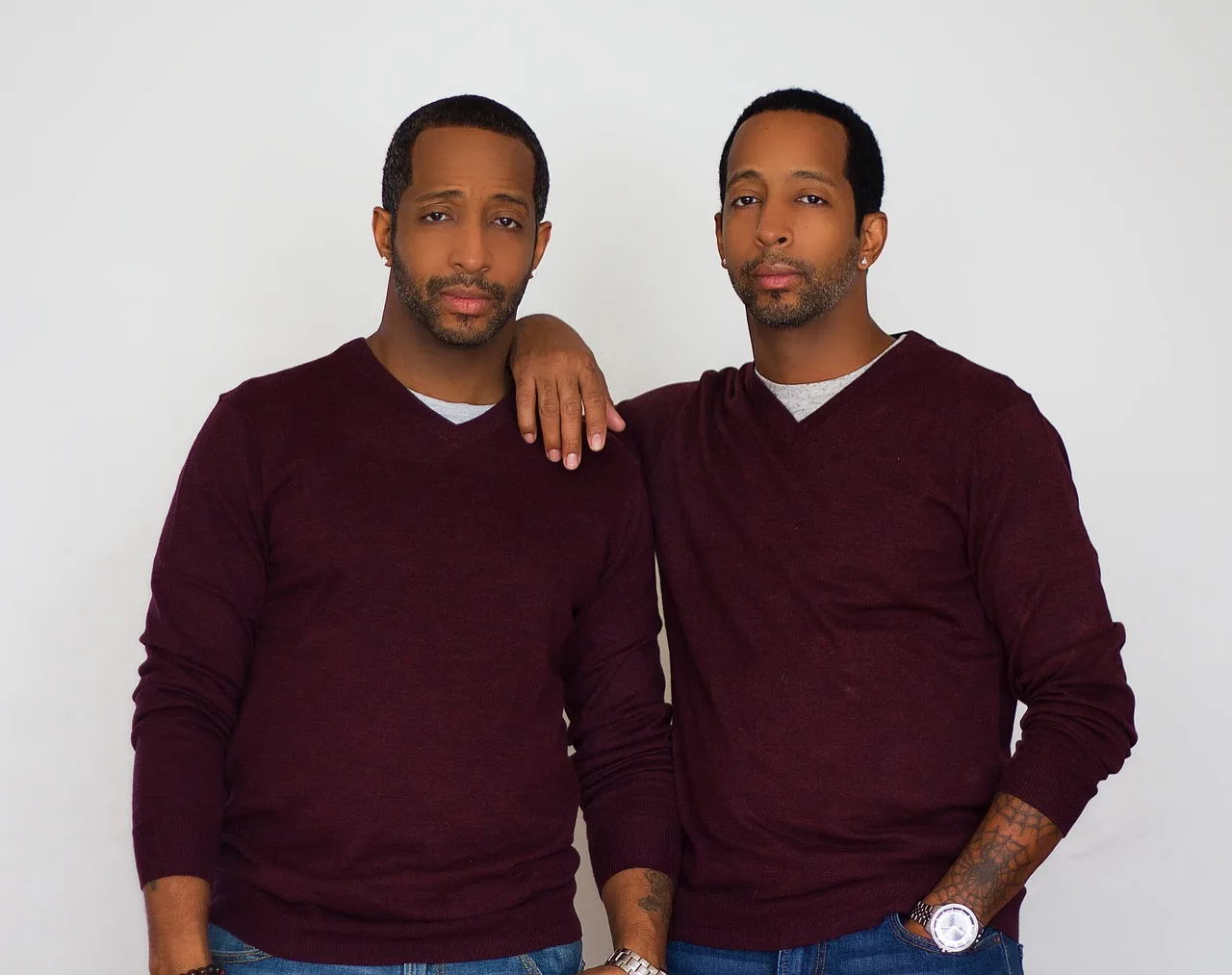
Maintenance
Part of Why musician lookalikes owe more to styling than to faces
Musician lookalikes pairs, tested against experience
Musician lookalike pairs come from bands and scenes, where one stylist, one photographer, and one shared album cover make separate faces read as a set.
What to take away
- Twins and brothers hold up bestRobin and Maurice Gibb, Don and Phil Everly, Angus and Malcolm Young.
- A line-up is styled as a unit first, so a pair claim taken from one band is mostly evidence about the styling.
- A claim holds only if the two faces still match in ordinary light, a decade apart, outside the band.
- Tribute work is booked per hour or per day, and the tax on the fee depends on the market.
Ranked: which pairs survive the styling
Ordered by the one test that matters. Does the resemblance hold outside the band, the suit and the studio light? A working comparison of the pairs, written for people who read faces for a living, sorts them along the same lines.
| Rank | Pair | Verdict on the face |
|---|---|---|
| 1 | Robin and Maurice Gibb | Twins. The match predates the 1977 suits. |
| 2 | Don and Phil Everly | Brothers. Bone structure. |
| 3 | Angus and Malcolm Young | Brothers. Holds without the uniform. |
| 4 | Ray and Dave Davies | Brothers. Holds without the tailoring. |
| 5 | Liam and Noel Gallagher | Brothers. Age separates them. |
| 6 | Mick Jagger and Harry Styles | Fails on the face. |
Testing the named pairs
Robin and Maurice Gibb. Twin brothers, born on the Isle of Man on 22 December 1949. The 1977 white suits, matching manes and matching teeth amplified what was already there. Photographs from before 1975 still show the same nose, brow and jaw.
Don and Phil Everly. Sons of the country duo Ike and Margaret Everly, born in Brownie, Kentucky, in 1937 and 1939. "Bye Bye Love" and "Wake Up Little Susie" both landed in 1957. The suits framed the match rather than making it.
Angus and Malcolm Young. Brothers born in Glasgow, Malcolm in 1953 and Angus in 1955. The family moved to Sydney in 1963, and the band formed there in 1973. Photographs without the schoolboy uniform still pair the two faces.
Ray and Dave Davies. Brothers from Muswell Hill, north London, born in 1944 and 1947. They formed the Kinks in 1963, and Dave played the riff on "You Really Got Me" in 1964. The tailoring carried the publicity shots.
Liam and Noel Gallagher. Brothers from Burnage, Manchester, born in 1972 and 1967. Noel joined his younger brother's band in 1991. Unposed shots still pair them, though age separates them now.
Mick Jagger and Harry Styles. Suits, flares and feathered hair carry the comparison. A 1968 Jagger photograph beside a 2019 Styles photograph shows different noses, jaws and brows. It fails on the face.
Jack and Meg White. The Detroit duo formed in 1997 and presented themselves as siblings. They had been married from 1996 to 2000. The match was a red, white and black dress code.
Jarvis Cocker and Pulp. Tall, thin, National Health glasses, a blazer. The reported resemblance sits between Cocker and his bandmates in 1995 publicity shots, where one stylist dressed five Sheffield men in the same charity-shop register.
Kiss. Full-face greasepaint erased brow, eye shape and jawline, so no pair claim about the band can be tested against a face.
Daft Punk. Robot helmets, worn from around 2001, remove the face from the comparison in the same way.
The Ramones. Four men in leather jackets, ripped jeans and identical bowl cuts, shot by a handful of New York photographers between 1976 and 1979.
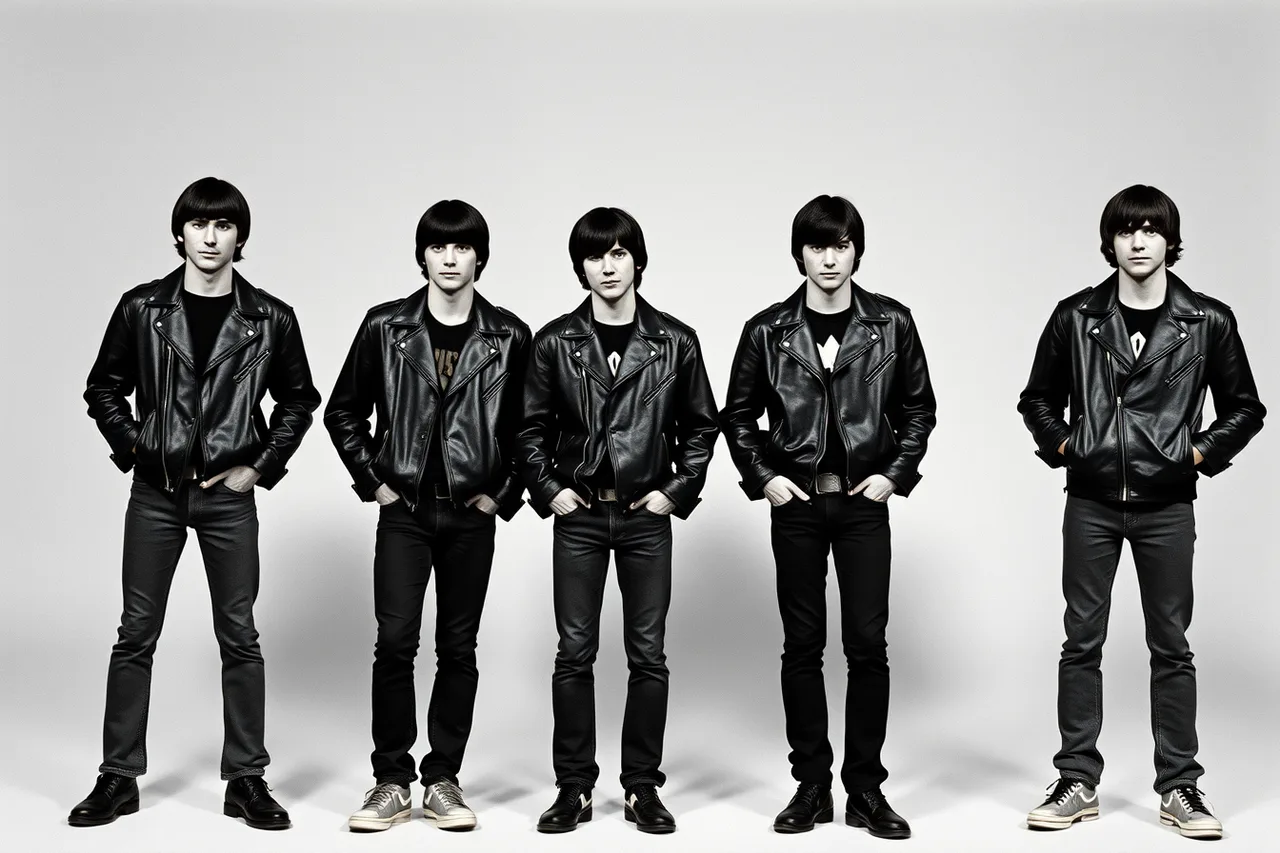
The Beatles, 1964. Four suits, four mop tops, one lighting setup. Hamburg-era photographs, taken before Brian Epstein's styling, show four visibly different young men.
The styling that sits over a musician's face is thickest in exactly these group portraits, which is why one band keeps producing pair claims.
One session, one lighting recipe
A band portrait is usually one session: one lighting setup, one lens and one grade for everybody. Photographic lighting keeps named conventions, and a single high, angled key producing a small triangle of light on the shadow cheek shapes every face the same way.
Where the shadow falls decides how prominent a cheekbone reads, how deep the eye socket looks and how wide the jaw appears. One recipe applied to five people makes those faces agree on all three.
Publicity photography is its own genre. The crop, the eye line and the retouching a market expects are inherited. Portrait making is taught and reused rather than invented at each session, which is why two acts from one period converge.
What a shared scene adds
| Shared by a scene | Effect on a face in a photograph |
|---|---|
| Hair and facial-hair fashion | Changes the frame around the face, the strongest single cue |
| Eyewear and headwear conventions | Removes or reshapes the brow and eye region |
| Cosmetic and grooming norms | Evens skin, alters brows, changes apparent proportion |
| A small pool of venue photographers | One lens, one seat and one lighting rig for many acts |
| A shared period of image processing | One grading fashion applied across a catalog |
Five shared inputs exist before any two people are compared. A pair impression formed inside that set is a report about a scene. If you want the same problem pair by pair, the working version of it covers what a photograph hides.
The check that usually settles it
- Find both people in different career phases, a decade apart.
- Choose a frame taken outside the band, in ordinary light, with no hat and no glasses.
- Compare nose, jaw and brow, not hair, eyewear or expression.
- Ask whether the photograph is unretouched, and check a primary source rather than a fan page.
For the Gibbs, that means a pre-1975 press photograph or a family snapshot. For the Young brothers, an early Sydney frame taken before the schoolboy uniform.
Run the same test on a booking claim. A tribute act quoting an hourly rate sells a performance, not a face. Rates vary by act, by market and by season, and a quote may be stated before or after tax.
Comparing US and Canadian totals matters more than the headline number, and a booking agency contracts the act rather than checking a likeness claim.