
Reviews
Part of Why Historical Lookalikes Rarely Hold Up
How to read historical lookalikes pairs skeptically
Historical lookalikes pairs can feel uncanny, but fixed old portraits and selected modern frames make the resemblance a product of image choice and editing.
Historical lookalikes pairs start with an old photograph and a living face. Somebody assembled every pairing in one direction: the old picture came first, since old pictures are scarce and a striking one is the whole reason to start.
The modern picture was then chosen from thousands to meet it. Know which half was fixed and which was fitted, and the pairing stops looking like a coincidence and starts looking like editing, which is what it is.
What to take away
- In a period-and-present pairing, one image is scarce and the other is selected from an enormous supply. Selection from a large supply is where the resemblance is manufactured.
- Converting the modern picture to monochrome, adding grain and cropping to the old format removes most of the differences before anyone compares the faces.
- A gap of a century does not make a resemblance more meaningful. It makes it less checkable.
- A pairing across time invites a story about descent. That story is a claim about a living person's family, and it is not one this site will make.
One fixed image, one chosen image
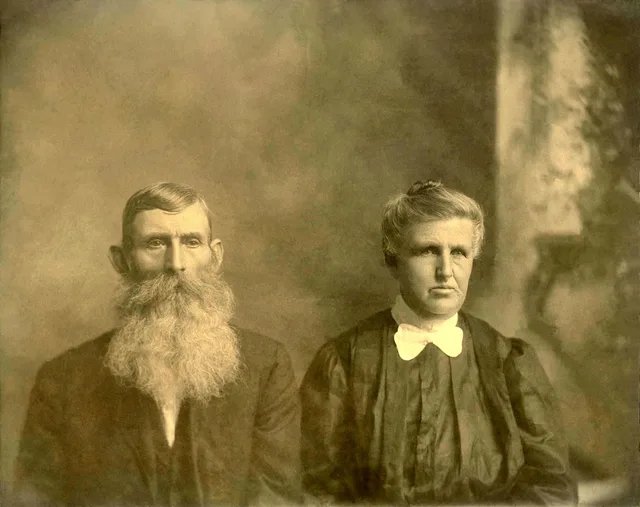
Fix the old photograph. It is a single exposure of a person who was photographed rarely, in a studio working to a standard commercial format that posed everybody the same way. The head was turned to the same angle, the light came from the same window. That photograph cannot be re-shot.
Now find a living person to place beside it. A well-known performer has been photographed at every angle, in every light, across decades, with every expression.
That supply contains a frame with the same head angle, lighting direction, and set of the mouth. The editor only has to find it, and the search is easy because the supply is large.
This is the whole method. The pairing does not show two people share a face; it shows a large enough archive of one face contains a frame that agrees with one frame of another.
That is true of almost any two faces of the same general build. The mechanics of side-by-side layouts show why the eye then finishes the job.
A named example: Abraham Lincoln and Daniel Day-Lewis
Use a photograph of Abraham Lincoln from the Library of Congress as the fixed image, then compare it with Daniel Day-Lewis as Lincoln in Steven Spielberg’s Lincoln (2012). This is a concrete period-and-present comparison, but not evidence of an independent facial match: Day-Lewis is portraying Lincoln, so costume, hair, makeup, pose, and frame selection help create the likeness. Compare the film image with an out-of-character photo of Day-Lewis before calling it a natural resemblance.
What the modern image goes through
The old picture stays as it is. The modern image may be altered in these ways:
- Convert it to monochrome.
- Add grain.
- Crop it to the old format.
Editing the modern image
- Convert to monochromeremoves skin, eye, hair color
- Add grain, soften focusremoves texture and asymmetry
- Crop to old formatremoves body, clothing, background
- Flip horizontally if neededremoves parting and tilt
- Match tonal rangeremoves contrast differences
Each step deletes a difference. None adds a similarity. By the end, the two images share a format, a palette, a grain and a crop, and a viewer who is asked whether they share a face has already been shown five things they share.
Run the process in reverse and the effect disappears. Put the old sitter in color, sharp, in a modern crop, and the resemblance to the performer usually goes with it. The period photograph was itself a manufactured object, and the modern half has been manufactured to match.
Time does not add evidence
A resemblance across a century feels stronger than a resemblance across a street, because it feels less likely. Think about what that likelihood is actually measured against.
Resemblance across a street vs a century
Across a street
- Evidence available
- Motion, speech, angles
- Testability
- Can check directly
- Feeling produced
- Ordinary
- Base-rate problem
- Not applicable
Across a century
- Evidence available
- One static image
- Testability
- Cannot test
- Feeling produced
- Uncanny
- Base-rate problem
- Only hits shown
Across a street, you can check: watch both people move, hear them speak, see them from another angle. Across a century you cannot, and only one image remains, with no motion, no second angle, often no reliable name.
The claim is not less likely to be true. It is less possible to test, and untestable claims feel uncanny the way ghost stories do: nothing can contradict them.
There is also a base-rate problem. Enormous numbers of old photographs survive. A pairing surfaces only when an editor finds one that fits; every archive photograph that did not fit stays in its box.
Showing only the survivors of a search is the oldest way to make a weak result look strong: you are shown the one hit and none of the misses.
The story the format wants you to tell
A pairing across time carries an implied plot. Either the living person is the sitter reborn, which nobody means literally, or the living person descends from the sitter, which people do mean and do repeat.
The second story claims something about a living person's family from a picture. That person did not ask for it.
It is the kind of statement the visual system generates from too little. It spreads with a name attached and cannot be recalled. This site does not speculate about anyone's ancestry from a photograph, and does not publish pairings that invite readers to.
If the sitter is a private person, an ancestor in somebody's attic, the objection is stronger. Their descendants are private individuals, and a viral pairing turns a family photograph into a public argument about their faces. The submissions policy excludes that material outright.
What to do with a pairing you find convincing
- Ask which half was fixed and which was searched for. Then imagine the search.
- Undo the edits in your headput color back, put the modern clothing back, sharpen the modern face.
- Look for a second image of the sitter. If none exists, you are comparing one exposure against a lifetime of them.
- As a manual check, compare facial landmarks—the eye line, nose, mouth, and chin—while accounting for pose and scale. This is a visual landmark comparison, not an identity test or evidence of ancestry.
- Notice whether the caption is making a claim about the face or about a family. Only the first is even in principle a matter of opinion.
Common questions
Is a monochrome comparison unfair by definition?
Not unfair, but not neutral. Monochrome removes real differences and should be understood as an edit, not as a levelling of the field.
Does a striking old-photograph match mean anything at all?
It means that within a very large supply of images, one frame of a much-photographed person agrees with one frame of a rarely photographed one. That is expected, not remarkable.
Why is descent never discussed here?
Because it is a claim about a living person's family that a photograph cannot support and the person cannot answer.